Saturday, 22 June 2013

Nectar required


RHS_Bee_FC1_N_RGBWe all know that honey attracts more bees than vinegar. But that is only because they just don’t like vinegar and it is nowhere to be found in flowers anyway. It is however also true that there are less and less patches to be found in cities and villages with bee-friendly flowers (and bee-friendly automatically means butterfly-friendly as well).

The ‘RHS Perfect for Pollinators’ label was developed in 2011 when writer and broadcaster Sarah Raven approached the charity with the idea of flagging up to gardeners plants most suitable for pollinators. As the Royal Horticultural Society says on the website : “…Bees visit flowers to collect nectar and pollen, which they use as food for themselves and the larvae in their hives or nests. By moving from flower to flower, they are important pollinators of many garden and wild flowers. Insect pollination is essential for the cropping of most fruits and some vegetables…

2013-06-02 Kew Gardens 011To explain things further, you could read Gail Rajgor’s blog on this subject or the article in the Daily Telegraph from July 2012.

And please do, but you could also, for the moment, stay on this blog and look at the pictures I took of bees, bumblebees and butterflies drinking nectar. What more encouragement do we need to make sure that these insects can keep on finding and drinking nectar…and pollinate our plants at the same time.

This Large Earth Bumblebee (Bombus Terrestris) was caught trying to get the last nectar out of a purple Azalea at Kew Gardens. But it shows exactly what the idea is: you get the lust but you carry the dust…

The first bumblebees to be seen in spring are the queens – the queen is the only bumblebee to hibernate through the winter. The queen is much bigger than the workers, which appear later.

As soon as the queen has found some nectar, to replenish her energy reserves, she starts looking for a suitable site to build her nest.The nest site is usually underground; an abandoned mouse burrow is often used. Inside, the queen first builds a nectar pot, which will sustain her during bad weather. She also begins to build up a pollen larder, which will feed her brood. ( source: Wikipedea)

Please look further below at my pictures of a Carder Bee (Bombus Pascuorum), a Red Admiral butterfly (Vanessa Atalanta), a simple honeybee (Apis Mellifera) and a Small Skipper (Thymelicus Sylvestris) respectively. And look for the RHS logo next time you buy your flowers and plants. Thank you!


2011-08-28 London Wetland Centre 030


2012-10-06 Copse Wood 003


2013-06-21 Kew Gardens 011


2011-07-22 Croxley Common Moor 001

Saturday, 15 June 2013

The simple but beautiful Gadwall, an update

2013-01-27 London Wetland Centre 004

The first blog that I wrote in this series was about the Gadwall (Anas Strepera). This very simple duck, that is called Krakeend in Dutch, is worthwhile showing again, since I have been taking pictures of it ever since. Therefore I present you, again, the “unknown duck”.

2013-05-27 London Wetland Centre 006The Gadwall is a bird of open wetlands, such as prairie or steppe lakes, wet grassland or marshes with dense fringing vegetation, and usually feeds by dabbling for plant food with head submerged. It nests on the ground, often some distance from water. It is not as gregarious as some dabbling ducks outside the breeding season and tends to form only small flocks. This is a fairly quiet species; the male has a hoarse whistling call, and the female has a Mallard-like quack. The young birds are fed insects at first; adults also eat some molluscs and insects during the nesting season. The Gadwall is one of the species to which the Agreement on the Conservation of African-Eurasian Migratory Waterbirds (AEWA) applies. (source: Wikipedea)

The male Gadwalls are predominantly grey with a distinctive black horizontal stripe through their eyes. The female Gadwalls look much like the very common Mallard Duck, but the bill is bright orange. Both sexes have a withe feather on their both sides.

They can be seen all year around in most of the places where you would see “normal” Mallard Ducks or Mute Swans.

I came across some very flexible Gadwalls, who seem to be swimming very calmly or grooming very fiercely.

Please enjoy this beautiful and yet very simple duck in the pictures below.


2012-12-30 London Wetland Centre 018


2011-12-22 London Wetland Centre 03


2013-01-27 London Wetland Centre 022 2012-09-16 London Wetland Centre 004

Saturday, 8 June 2013

Kew Gardens: a handful of glasshouses with some plants and flowers

2011-06-04 Kew Gardens 054

Princess of Wales Conservatory

The Royal Botanic Gardens, better known as Kew Gardens, are situated between Richmond upon Thames and Kew; it is a place of sheer beauty and horticultural diversity. I recently became a member, again, and in this blog I would like to show some of the pictures I took during my visits over the last three years. Although there are many different and very colourful flowers and plants to be seen throughout the year, I will concentrate more on the unique buildings in the garden.


2011-06-04 Kew Gardens 046 (857x1280)

UNESCO recognised Kew Gardens as a heritage site in 2003 as entry nr.1084 and describes the gardens as follows:2011-06-04 Kew Gardens 042 (857x1280)

“..Set amongst a series of parks and estates along the River Thames' south-western reaches, this historic landscape garden includes work by internationally renowned landscape architects Bridgeman, Kent, Chambers, Capability Brown and Nesfield illustrating significant periods in garden design from the 18th to the 20th centuries. The gardens house extensive botanic collections (conserved plants, living plants and documents) that have been considerably enriched through the centuries. Since their creation in 1759, the gardens have made a significant and uninterrupted contribution to the study of plant diversity, plant systematics and economic botany..”

The Princess of Wales Conservatory, as seen left and above, is the newest glasshouse in the garden. It was commissioned in 1982 to replace a group of 26 smaller buildings that were falling into disrepair. It was named after Princess Augusta, founder of Kew, and opened in 1987 by Diana, Princess of Wales.

Inside are various computer controlled zones representing different climates from desert to tropical and rainforest. But a simple bed of Lavender outside already makes a spectacular impression for an innocent (and most of the time plant-ignorant) amateur photographer like me. I do like the modern design of this glasshouse. A modern rock garden with waterfalls outside the conservatory, as seen on the right, makes this part of the garden very pleasant to visit…and take pictures of.


2013-06-02 Kew Gardens 023 (828x1280)

If you want to get closer to some of the trees at Kew Gardens, the best way is to climb the 18 meters high Treetop Walkway. That climb and walk around is not for those with vertigo. Because the floor is very transparent and the whole experience is a bit wobbly.

2011-06-04 Kew Gardens 102But once you are upstairs and used to the height, you can see the top of the trees inside the walkway as well as Temperate House, another glasshouse that is situated close by.

And inside this glasshouse, there is of course an abundance of beautiful and very exotic flowers, like the one below that I do not know the name of, but is very, very nice indeed.

2011-06-04 Kew Gardens 109


The oldest glasshouse at Kew Gardens is the Palm House. It was built between 1844 and 1848 by Richard Turner after a design by Decimus Burton. It is truly iconic, because when you see this building you immediately think “Kew Gardens”.


2013-06-02 Kew Gardens 001 (1280x853)

To finish this blog and to show that there are certainly a lot of colourful plants and flowers to be seen in Kew Gardens, two pictures of Azalea’s and Roses respectively. Of course taken at different times, because that is the fun: there is always something different to be seen, in full bloom or not, in Kew Gardens.

2013-06-02 Kew Gardens 002 (1280x801)


2011-06-04 Kew Gardens 027 (857x1280)

Saturday, 1 June 2013

Teals, a variety of dabbling ducks

2013-03-02 London Wetland Centre 020The top banner of this blog shows 7 male and 1 female Common Teals. Whilst I believed this to be a good choice because it is a nice stretched picture, I also believe this duck to be one of the most beautiful ones existing. And as I wrote before: there is nothing common about the Common Teal.

The dictionary describes the word teal as: any of several small, short-necked freshwater ducks, especially of the genus Anas, that feed on the surface of the water and often have brightly marked plumage. And if you go into the etymology of the word, you will find descriptions like: early 14c., probably from an unrecorded Old English word cognate with Middle Dutch teling "teal," Middle Low German telink, from West Germanic “taili”. As the name of a shade of dark greenish-blue like the colour patterns on the fowl's head and wings, it is attested from 1923. The Dutch word for teal is indeed Taling.

The Common Teal or Anas Crecca is a duck that can be seen mainly in the winter in England and The Netherlands, because they breed in Finland and other parts of Scandinavia during the summer. They can also be found in Russia in the sum2012-10-21 London Wetland Centre 018mer.

The Dutch name is Wintertaling which translates as winter teal. They find their food just under the surface as they would, being a teal.

But their most remarkable feature remains their very bright colours with a green patch on the eye for the males and a very bright green feather on their left side for both sexes. 

In this blog I will show some pictures of different types of teals. They all are remarkably beautiful as I hope these pictures will show.


2011-06-11 London Wetland centre 018The Agreement on the Conservation of African-Eurasian Migratory Waterbirds (AEWA) is an intergovernmental treaty dedicated to the conservation of migratory waterbirds and their habitats across Africa, Europe, the Middle East, Central Asia, Greenland and the Canadian Archipelago. In June 1995 the final negotiation meeting was held in The Hague. The Meeting adopted the Agreement by consensus and accepted with appreciation the offer of the Government of the Kingdom of the Netherlands to act as Depositary.

One of the ducks that is conserved under this treaty is the Cape Teal or Anas Capensis. They can be seen all year round in sub-Saharan Africa, but there are also some in Regent’s Park in London as well as in WWT London. Their distinctive red bill makes them very recognizable.


2011-10-15 London Wetland Centre 018Another teal that is protected by AEWA is the Marbled Teal or nowadays called Marbled Duck. Because they do dive as well for their food. Their Latin name is Marmaronetta Angustirostris. They can be found all over Asia, with concentrations in Turkey and Armenia as well as Iraq.

They tend to be quite gregarious, especially during the nesting/breeding season. Before moving from the wintering grounds to the spring breeding grounds, pairs form strong seasonal pair bonds that lasting until incubation. The female incubates between 4 and 12 eggs.

They normally live near fresh and brackish shallow pools, boggy lakes and marshes with abundant vegetation, within lowland arid country. In the winter it uses larger, more open waters and temporary pools (Source: Dudley Zoological Gardens).


2013-05-27 London Wetland Centre 023Again form the sub-Saharan region and again protected by AEWA is the teal with the most funny name and funny colours: the Hottentot Teal or Anas Hottentota.

Especially their very blue bill is a distinctive feature.

2012-09-22 London Zoo 017


Crossing over to South America, you will find the Ringed Teal or Callonetta Leucophrys. They breed in north-west Argentina and Paraguay, but also in Bolivia, Brazil and Uruguay. Their habitats include tropical, swampy forests and marshy clearings in well-wooded lowlands, as well as secluded pools and small streams.
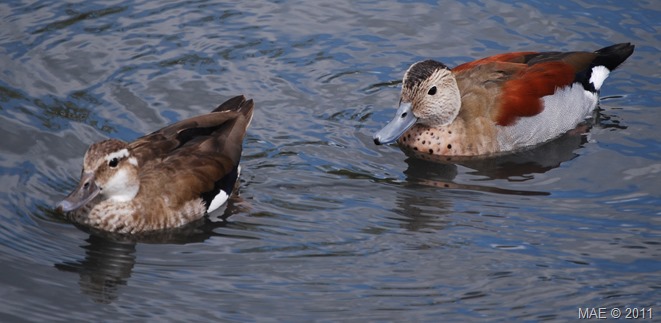
2011-07-09 London Wetland Centre 049

I have seen them in WWT London as well as in Regent’s Park. They look a bit like those wooden ducks you use during the hunt to lure ducks towards you.


2013-02-16 Regent Park 003And to finish the tour of teals around the globe, here is an Australian teal: the Chestnut Teal or I Anas Castanea. And since survival is paramount in Australia, they are omnivores and are indifferent to saline water.

Chestnut Teals form monogamous pairs that stay together outside the breeding season, defend the nest site and look after the young when hatched. Nests are usually located over water, in a down-lined tree hollow about 6–10 m high.

Sometimes nests are placed on the ground, among clumps of grass near water. The young hatch and are ready to swim and walk within a day. (source: Wikipedia).


Apart from the Common Teal, the only other native teal in England is the Garganey or Anas Querquedula. They are true globetrotters and arrive in the spring, around May in Europe. But so far, I have not seen one. Therefore I have to settle for the Wikipedia webpage…and keep looking for them. A nice mission for the coming period!

Wednesday, 29 May 2013

Ablution, to come clean with yourself

2012-09-16 London Wetland Centre 010Every morning, we start the day by taking a shower, brushing our teeth and if necessary shaving or combing our hair. We normally have two hands with normally five fingers each, so there is not an awful lot of difficulty in that activity.
If you are a male Pochard however, you have to find other ways to do the business. Balancing on a piece of wood with only your bill to make some effort is not for the faint-hearted.
Standing save ashore, when you don’t h2012-05-29 Ruislip Lido 002ave to do the balancing act as this Tufted Duck is showing looks already much easier. But still the restriction of only a bill to take care of things is rather limiting.


2013-01-05 Whipsnade 017There is always a graceful exception to the rule: this Stork is able to balance on just one leg and still groom itself perfectly.


In this blog I will show various methods of ablution of various animals with only one purpose: to do your best to look the part.


I will show you a Black-footed Penguin, a bathing Red-crested Pochard, a Meerkat with a lot of sand to clear out of it’s fur and two Black-capped Squirrel Monkeys helping each other. Especially the mammals, like myself, have a huge advantage with their arms and claws.


No matter what method they use, cleverly or just out of necessity, I am very pleased that all animals (except perhaps for pigs) take some time to clean, groom and polish them for my pictures. Which gives me the opportunity to show off on their behalf.


2013-02-16 London Zoo 002

2011-11-19 London Wetland Centre 12

2011-05-21 Whipsnade 052

2013-02-16 London Zoo 018

Monday, 27 May 2013

Wildfowl & Wetland Trust

Today I renewed my membership of the Wildfowl & Wetland Trust (WWT). This organisation was founded in the UK in 1946 by the late Sir Peter Scott and is one of the world’s largest and most respected wetland conservation organisations working globally to safeguard and improve wetlands for wildlife and people.

When Sir Peter Scott founded the WWT, his ideas were unique. He was the first to recognise the wisdom of the combined approach of taking action to save wetlands and their wildlife, while encouraging the public to care about the natural world. He also pioneered the notion that conservation education should be uplifting and fun for people of all ages - that wetlands are places to enjoy as well as to respect. Sir Peter's principles remain at the core of WWT's work and are central to our future plans. The WWT complements wetland conservation work carried out worldwide with a network of UK visitor centres comprising 2,600 hectares of globally important wetland habitat. (Source: WWT website)


Peacock Tower at WWT London. MAE © 2011
So far, I have visited WWT London many times but WWT Arundel only once. And every time it is a mere pleasure to perambulate from bird hide to bird hide, of course with the camera close by, and enjoy the birdlife through all the seasons. It was in WWT London that I saw the Common Teal for the first time. During a little boat trip in WWT Arundel you can see the delicate but beautiful Water Voles peeping their heads outside the reeds, to see who is on board.

The best example of the conservation work that the WWT does must be the saving of the Madagascar pochard. Until recently, the Madagascar Pochard was believed extinct, the last sighting having been in 1991. In November 2006, however, staff from the Peregrine Fund (TPF), rediscovered the species on a small lake ‘the red lake’ near Bemanevika, 300 km north of the last known site; 20 mature birds and possibly nine ducklings were reported at the end of 2006.
Despite numerous logistical difficulties this proved successful, and at the end of 2009 three clutches had been successfully hatched with over 20 ducklings reared and held in temporary accommodation in advance of the construction of a conservation breeding centre. Project staff maintain a constant presence at the red lake to ensure protection of the birds and the lakes and surrounding forest have been submitted for designation as a protected area (Source: WWT website).

As a tribute to this wonderful organisation, I have posted some of my pictures, taken in one of the two aforementioned visitor centres. Next stop, as far as I am concerned: WWT Slimbridge, the first centre that Sir Peter Scott opened.

Red-breasted Geese at WWT Arundel. MAE © 2012

Many Cormorants, Grey Herons and and various gulls at WWT London. MAE © 2013
Eider ducks in their save enclosure at WWT London. MAE © 2013
One of the islands at WWT London in full bloom. MAE © 2011


Friday, 3 May 2013

Great Crested Grebe

MAE © 2011
The Great Crested Grebes are definitely back in the waters and are preparing for their mating rituel. I have yet to see this beautiful ballet, but the footage on the internet promises something spectacular. In Dutch this bird is known as a Fuut; the Latin name is: Podiceps Cristatus.

As I mentioned earlier, the Great Crested Grebe has an elaborate mating display. Like all grebes, it nests on the water's edge, since its legs are set relatively far back and it is thus unable to walk very well. Usually two eggs are laid, and the fluffy, striped young grebe are often carried on the adult's back. In a clutch of two or more hatchlings, male and female grebes will each identify their 'favourites', which they alone will care for and teach

Unusually, young grebes are capable of swimming and diving almost at hatching. The adults teach these skills to their young by carrying them on their back and diving, leaving the chicks to float on the surface; they then re-emerge a few feet away so that the chicks may swim back onto them (source: WikiPedia)


 MAE © 2013

The Royal Society for the Protection of Birds, or RSBP for short, was formed to counter the barbarous trade in plumes for women's hats, a fashion responsible for the destruction of many thousands of egrets, birds of paradise and other species whose plumes had become fashionable in the late Victorian era

There had already been concern earlier in the century about the wholesale destruction of such native birds as great crested grebes and kittiwakes for their plumage, leading to such early legislation as the Sea Birds Preservation Act of 1869 and the Wild Birds Protection Act of 1880, but the trigger which led to the foundation of the Society for the Protection of Birds in 1889 was the continued wearing of ever more exotic plumes. Indeed the young Society was so successful that it was granted its Royal Charter in 1904, just 15 years after being founded 
 (source: RSPB Website).

To celebrate the beauty of this very strange bird, I will finish with three more pictures I took in the last couple of years.

MAE © 2013


MAE © 2011


MAE © 2012