Sunday, 24 November 2013

Weekend Surprises

2013-11-23 Ruislip Lido 009

2013-11-24 Parakeet in the Garden 001This weekend was full of surprise encounters. First a little story. In 1951 the Hollywood movie “African Queen”, with Humphrey Bogart and Katherine Hepburn, was partly shot at Isleworth Studios in Middlesex. The story goes that a pair of Rose-ringed Parakeets (Psittacula Krameri) escaped and settled in the surrounding neighbourhood. Whether this is true or not I don’t know, but nowadays there are around 50,000 of these birds flying around in London.

This afternoon I saw about three in a tree in my garden, and they stayed long enough for a decent shot.

2013-11-24 Parakeet in the Garden 003

They normally fly in groups of at least 5 and make quite some noise in the air.

But it is always a funny sight to see these cute birds in your garden. You feel in a different world, just as Humphrey (who won an Oscar for Best Actor for his role) and Katherine.


2013-11-23 Ruislip Lido 001Last week I saw a handful of Little Egrets (Egretta Garzetta) in a tree near Ruislip Lido. In the past I had seen just one every now and then in that area, but I was presently surprised to see so many together. Of course I had to revisit the actual site and so I did yesterday. The surprise was even bigger, since about a dozen were flying up and down the trees.

Unfortunately, you can not approach them totally silent and they flew away the moment I came too close. But waiting a while (as quiet as possible) helped a little in making these shots.

I was even able to take a picture of two of them in flight as is shown below. I will definitely return to this “scene of crime”.


2013-11-23 Ruislip Lido 002

Talking of birds in flight: I also took some shots at the Ruislip Lido of three Canada Geese (Branta Canadensis) and a Muted Swan (Cygnus Olor) in full flight. It is always a thrill to see these shots being sharp enough to share (in stead of deleting them straight away). The picture at the beginning of this blog showed the occasion for the flight: there was some food on offer further down the Lido…and they all had to tuck in.

2013-11-23 Ruislip Lido 010 2013-11-23 Ruislip Lido 007

I will finish this blog with a picture of a Eurasian Jay (Garrulus Glandarius) that seemed to be as surprised as I was this weekend of the variation of birdlife, just around the corner.

2013-11-23 Copse Wood 001

Monday, 11 November 2013

Shovelling along

2013-02-17 London Wetland Centre 013

2013-11-10 London Wetland Centre 016Today I saw quite some Northern Shovelers (Anas Clypeata) in London Wetland Centre. And I realised that I never wrote a blog about this typical duck. It’s name is obviously derived from the unique (and not so pretty) bill, with which they can do all kind of useful things. especially when it comes down to getting food.

They feed by dabbling for plant food, often by swinging its bill from side to side and using the bill to strain food from the water. They use their highly specialized bill (from which their name is derived) to forage for aquatic invertebrates – a carnivorous diet.

Their wide-flat bill is equipped with well-developed lamellae – small, comb-like structures on the edge of the bill that act like sieves, allowing the birds to skim crustaceans and plankton from the water's surface (source: Wikipedia).


But I have seen that their bill can also be used for other activities, such as scratching, fighting etc.

2011-09-24 London Wetland Centre 016

2013-02-17 London Wetland Centre 029The colours of the male (outside the eclipse period) are very distinctive and quite remarkable. A white base chest with a brown underbelly. Very bright dark-green head and beautiful black and white feathers on the back. The colours do compensate the ugly broad bill.

The female Shoveler has typical female duck colours, but with the different bill. They must eat as well after all.

2011-09-23 Ruislip Lido 004


I will finish with a picture where both male and female Shovelers can be seen. It was taken in London Wetland Centre.

Another wonderful duck, that’s for sure!


2013-02-17 London Wetland Centre 015

Monday, 4 November 2013

Goose Bumps

2013-05-27 London Wetland Centre 020

2013-08-10 Slimbridge Wetland Centre 020With the autumn definitely started, there will be thousands and thousands of geese coming to this side of Europe. But there are also geese who are permanent residents of the UK, such as the Canada Geese (Branta Candensis) as shown in the banner who are quite frankly turning into almost a pest in this part of Europe.

Nevertheless, this blog is all about geese and the beautiful variety there is amongst them.

The first type to show is the White-fronted Goose (Anser Albifrons). They are very recognizable with their white band around the orange bill. They breed in Russia or Greenland, but fly to our shores in the Autumn. The picture on the left was taken in Slimbridge Wetland Centre where they are living all year round. But I still need to see the White-fronted Geese in the wild, so this picture has to do for the moment.

2012-08-11 Arundel Wetland Centre 023

They do have a little cousin, the Lesser White-fronted Goose (Anser Erythropus) that is smaller in size and has a more pink coloured bill. They rarely come to the UK for the winter, although with a reintroduction program in Sweden, this may change.

On this picture you can also see the Red-breasted Goose (Branta Ruficollis). The Red-breasted Goose is one of the species to which the Agreement on the Conservation of African-Eurasian Migratory Waterbirds (AEWA) applies. They are normally staying near the Black Sea during the winter and breed in North Russia (Siberia).

Sometimes you see them in north-west Europe, where they will stay in small groups during the winter, in amongst other geese. Their colours however are very distinguishable. This picture (as well as the one above) was taken at Arundel Wetland Centre.

2012-08-11 Arundel Wetland Centre 022

2013-01-26 Little Britain Lake 002But if you don’t like the coloured geese, you can always refer back to the domestically bread Embden Goose (Anser Anser Domesticus). Men have created this breed and you can find them in parks, at farms and basically everywhere throughout the year, since they do not migrate.

2011-08-13 Uxbridge 004

There are many more types of goose that I could show you. But let’s finish with the Greylag Goose (Anser Anser). It is in fact the ancestor of the domesticated Embden Goose and is also non migratory. I give you: the original goose.

2013-10-06 London Wetland Centre 020

Friday, 25 October 2013

The Rare House Sparrow

2013-10-20 Ruislip Lido 015

2013-02-16 London Zoo 015Everybody knows the simple House Sparrow (Passer Domesticus). It is (or should I say: was) the first bird you learn to recognize and every garden in the country has them as a visitor…or not. Because the RSPB website gives some daunting facts:

House sparrow numbers have dropped nationally over the last 25 years (BTO various data). In Greater London they declined by 68 % between 1994 and 2009 (BTO Breeding Bird Survey data) - and sparrows are now absent from many areas of central London where they were once common.

Recent research has shown house sparrows in urban areas suffer from a lack of invertebrates (insects) to feed their young. This was shown by a study in Leicester, where poor condition and death of young chicks was linked to low numbers of invertebrates in their diet (RSPB and De Montfort University study). A large-scale feeding experiment in London (RSPB study) has demonstrated the importance of invertebrates for the survival of young chicks. Through this project, we tested more natural ways to increase the numbers of invertebrates available to sparrows and other birds in our urban green spaces.

And to be quite honest: I haven’t seen them so much lately. But there is hope. Their decline has been addressed by all kind of projects lately and the facts and figures gathered in those projects (e.g. House Sparrow numbers in relation to insect availability) will help to move to the next step: to bring these little friends back to our urban wildlife.

In order to make the case for the House Sparrow and their re-introduction, I will show some of the few pictures I made of them.

2013-10-20 Ruislip Lido 014 2013-10-20 Ruislip Lido 013

Even if they are merely brown and grey, they are quite pretty little birds and definitely worth preserving. I will finish this blog with a picture I took a couple of years ago of four females chatting along (as they do) on a fence.

2011-07-13 Ruislip Lido 007

Friday, 18 October 2013

Ruislip Lido

2011-06-25 Ruislip Lido 014

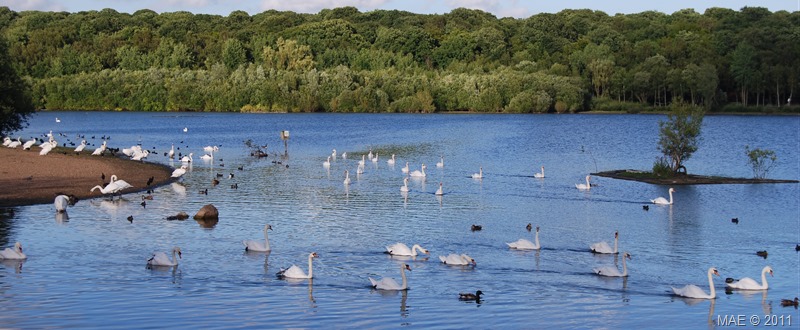
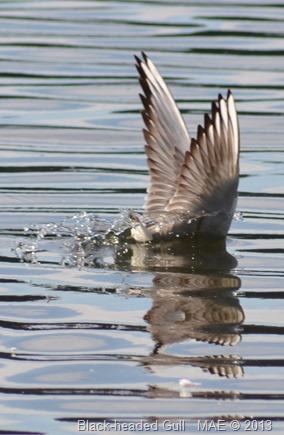
2013-09-15 Ruislip Lido 001I had one of my many walks around Ruislip Lido today. When I returned home I realised I never wrote about it in my blog. And that is not fair, since it is a very pretty little pond with a cute steam train running around it. Apart from the usual swans and ducks you would find in such urban nature reserves, I have come across some other interesting birds as well. I also came across birds doing interesting things, such as this Black-headed Gull (Chroicocephalus Ridibundus), diving for something.

Originally opened as a feeder reservoir for the Grand Junction Canal in 1811, the reservoir was reopened in 1933 as a lido, with facilities for swimming and boating. A narrow gauge railway, the Ruislip Lido Railway was opened in 1945, and now runs about two thirds of the distance around the reservoir.

Having fallen into a state of disrepair during the 1970s and 1980s, the lido has since undergone renewal works, and was the subject of an enhancement project unveiled by the London Borough of Hillingdon in January 2010. The project involved the return of boating and swimming in the reservoir, which had previously not been possible due to pollution and an artificially low water level (Source: Wikipedia).

In this blog I will take you along on the various journeys I had around the Lido and show what I saw. Mostly beautiful and often surprising. But always a joy of variation and difference.


Their must be enough fish in the Lido, because you often see Common Terns (Sterna Hirundo) fly above it…and dive for some food!

 2013-07-20 Ruislip Lido 001

My favourite duck, the Tufted Duck (Aythya Fuligula) is a permanent resident…and there are quite a few around. They normally swim against the main stream because they don’t care for the offered bread that the spectators bring along. I did see one once ashore, which is not often seen.

2012-05-29 Ruislip Lido 001 2012-05-29 Ruislip Lido 002

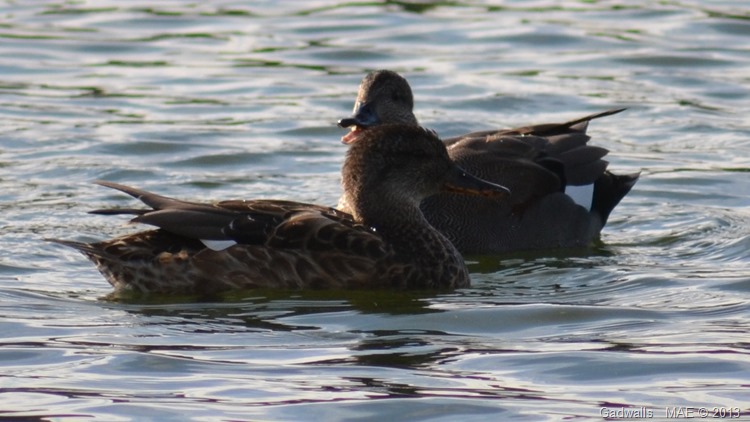
Lately I have seen more and more Gadwalls (Anas Strepera) at the Lido. They seem to feel at home between the normal residents and since they are non migratory, they are here to stay.
2013-09-15 Ruislip Lido 004

This winter I came across some unexpected visitors: the Little Egret (Egretta Garzetta) and the Yellow Wagtail (Motacilla Flava). They were not frightened off by the snow and the cold weather.

2013-01-11 Ruislip Lido 003 2013-01-19 Ruislip Lido 001

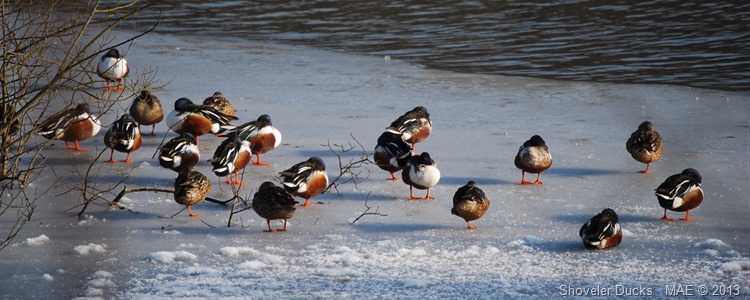
And there are of course many, many Muted Swans (Cygnus Olor), Mallard Ducks (Anas Platyrhynchos) and Canada Geese (Branta Canadensis) in the water and ashore throughout the year. They are very common in these sort of places. But I would like to finish with a picture of a large group of Shoveler Ducks (Anas Clypeata) that I saw in the winter of 2012. That was a real treat! It is always a privilege to see the water birds at the Ruislip Lido. I hope you enjoyed this introduction. Come and have look…
2012-02-11 Ruislip Lido 001

Friday, 11 October 2013

Hurray for the Wigeon

2012-04-15 London Wetland Centre 009


And indeed, they do have a distinctive whistle. Listen to this clip you will understand what I mean.

Funny enough, I have always been fascinated by the Wigeon (Anas Penelope). Firstly, the name is quite funny in many languages. Some examples: in Dutch it is called Smient, in German it is called Pfeifente and in French is has the same name (whistle duck): Canard Siffleur. But I think the Danish name is the best: Pibeand (still meaning whistle duck).


2012-12-30 London Wetland Centre 008It is not only it’s name and it’s whistle that makes this duck so interesting. Because secondly, it does behave like a goose (migratory and feeding on land) and thirdly, the colours are just magnificent.

They breed of course in the summer, but almost nowhere in the UK. They do prefer the northerly parts of Europe, such as Iceland, Scandinavia and Russia. They can even be found breeding in Siberia, hence their official name: Eurasian Wigeon.

Their habitat is always close to lakes with plenty of grassland ashore to feed.

There are millions of Wigeons worldwide; they can live for about 15-20 years. With a strong health and no known diseases on record they are not considered to be endangered.

So much for the facts and figures. This blog was actually meant to show some pictures of this beautiful little duck.

This picture was taken in Regent’s Park (London). Although these two are permanent resident, it shows the beautiful colours and pattern the male as well as the female Wigeon has.

2012-01-07 Regent Park 005

Talking of the funny whistle that the Wigeon can produce: the picture on the left was taken in London Wetland Centre and it shows how it produces it sound. The picture on the right is of one of the early females that returned this year to the London Wetland Centre.

2012-06-02 London Wetland Centre 011 2013-10-06 London Wetland Centre 009

To finish this blog, a picture from the penultimate day of last year: many Wigeons grazing like geese on a pasture green.

2012-12-30 London Wetland Centre 009

Sunday, 6 October 2013

Autumn at London Wetland Centre

2013-10-06 London Wetland Centre 008

Autumn started officially three weeks ago but today it still felt as if it was summer. I read on the website of London Wetland Centre that already 70+ Wigeons (Anas Penelope) had returned for the winter period. Enough reason to visit the wetland centre and see for myself how autumnal it already looked and  felt.

Eventually 2013-10-06 London Wetland Centre 021I did find the Wigeons although it took me a while before I spotted them; they were further away than I hoped.2013-10-06 London Wetland Centre 006

They are quite social and are not unkind to the neighbours, when they want to enjoy the sun as well.

And with so many Gadwalls (Anas Strepera) around, there is no way you should not share your little island anyway. Below another pair of the many dozens that have arrived in London.

2013-10-06 London Wetland Centre 011

There are quite a lot of Gadwalls around. They are in England the whole year, but from now on they have to share their habitat until the migrants fly north again.

2013-10-06 London Wetland Centre 004

2013-10-06 London Wetland Centre 017But not only the water birds are preparing for the winter. The Common Darter (Sympetrum Striolatum) wants to make sure there are enough fertilized eggs in the pond before he dies. So the next generation can do it all over again, the next year.

2013-10-06 London Wetland Centre 015Some other dragonflies, like this Migrant Hawker (Aeshna Mixta), will not fly much longer, given the state of it’s wings.

2013-10-06 London Wetland Centre 016

It won’t be long before the dragonflies and damselflies have all died. That is inevitable. Let’s just enjoy their beauty as long as possible until the next generation shows up, next summer.

To finish this blog, just another picture of one of my favourite geese: the “Greylag” (Anser Anser). I think that my next blog will have much more mushrooms, autumnal colours and returned migrants to show. I can’ t wait for the autumn to really begin!

2013-10-06 London Wetland Centre 020